Shaping Africa's Leadership Future – One Story at a Time.

We believe leadership is personal. That’s why our insights go beyond trends — they tell real stories of real leaders, navigating real challenges.

At Hallé Search, executive search is never just about filling a role — it’s about people. Their values. Their vision. Their impact on businesses, industries, and communities.


What we do

Strategic Talent Identification

At the heart of our work is one belief: leadership success depends on alignment — of strategy, values, and vision.


Executive search rooted in people

We offer retained, high-touch executive search solutions tailored to each client. Combining global best practices with deep knowledge of Africa’s talent ecosystem, we build searches from the ground up — from role definition to onboarding. We go beyond CVs, using structured interviews, competency frameworks, and written evaluations to ensure every candidate is the right fit for your organisation’s strategy and culture.

Talk to us

Executive search  //  from the ground up

We uncover exceptional, diverse leadership talent - including individuals who aren't actively seeking new roles. Our regional expertise gives you a real-time view of Africa’s executive talent pool, so you can make confident, future-ready decisions.


Our Search Process

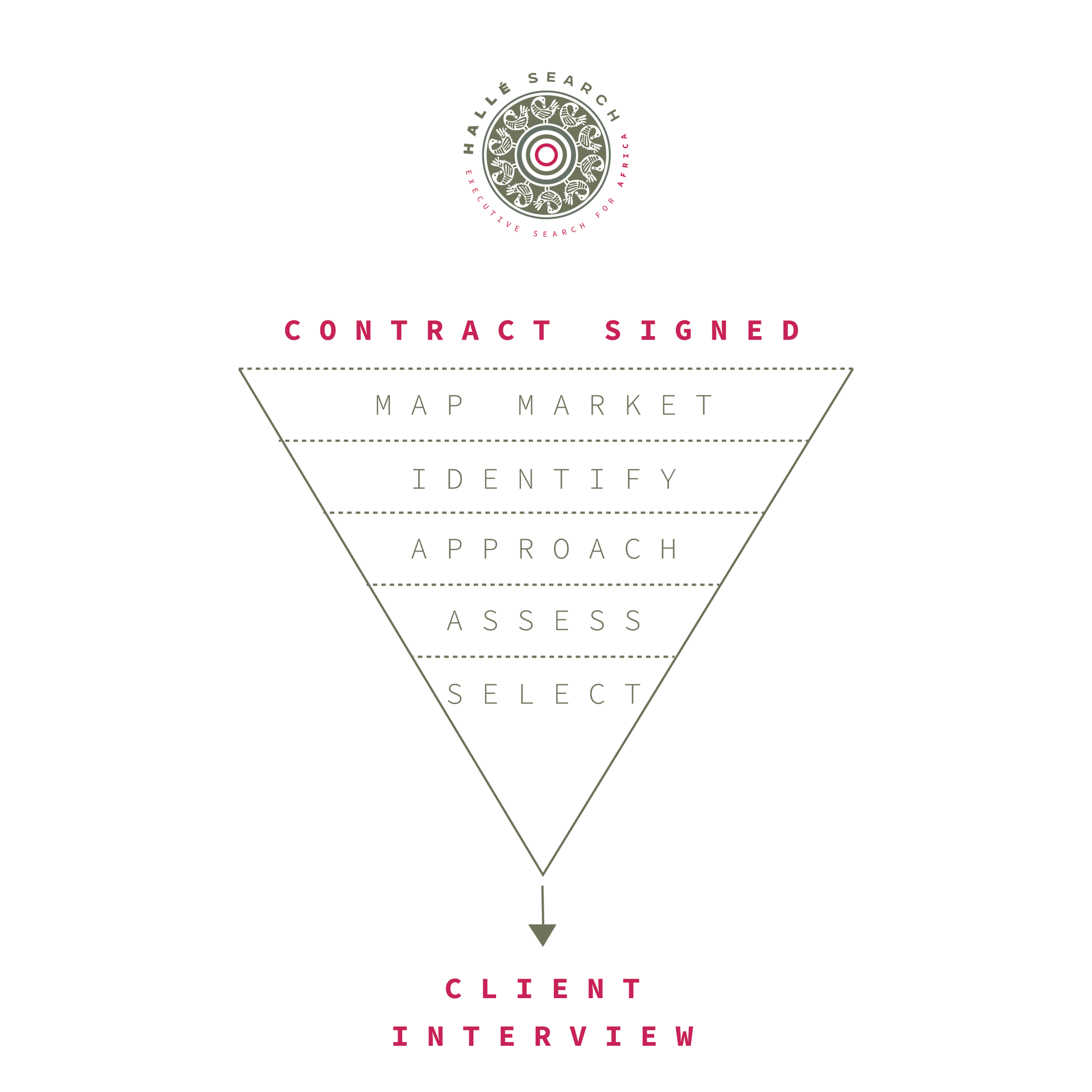
A Structured, Insight-Led Process — Built for Results

We combine rigor with agility at every step of the search:


  1. Stakeholder Briefing
  2. Market Research & Talent Mapping
  3. Candidate Outreach
  4. Initial Screening & Evaluation
  5. Competency Interviews & Written Assessments
  6. Shortlist Presentation (Week 4)
  7. Client Interviews & Advisory Support
  8. Final Selection & Offer Management


Each stage is designed to give you confidence — grounded in data, not assumptions.
Talk to us

Founder’s Note

"Leadership is deeply human."


I started Hallé Search with a simple belief: that exceptional leadership changes everything. Not just for organisations, but for people and societies. We evaluate more than experience — we assess the values, behaviours, and resilience that define transformative leaders. Africa is at the centre of our work,  and with every search, we aim to elevate the next generation of talent driving the continent forward.


Because we don’t just fill roles —
We build leadership legacies.


Nicki Hallé Founder, Hallé Search

About us

client TESTIMONIAL  //  I was searching for an expert...

I was searching for an expert in recruitment within the African market to gain additional insights and further advice on conducting business across the continent. I was referred to Nicki—and I have to say, the experience has been nothing short of remarkable. Nicki’s deep knowledge of the African recruitment landscape, coupled with her practical, no-nonsense approach, provided me with invaluable clarity and direction. Her insights were not only informative but also transformative in shaping how I now view opportunities in Africa. If you’re looking to understand or expand your recruitment options into Africa, I couldn’t recommend Nicki highly enough. Her expertise, professionalism, and genuine passion for connecting businesses to the African market make her an exceptional partner in this space.

Mark Coetzee – CEO, MC³ International // READ MORE >>

NEWS ARTICLES  // 

December 3, 2025
Africa’s leadership hiring landscape is undergoing a significant transformation as businesses adapt to rapid digitalisation, global capital flows (or lack thereof), and socio-political shifts. In 2025, several key trends are shaping how organisations attract and retain executive talent across the continent. 1. Local Talent with Global Exposure There’s growing demand for African leaders who combine deep local market understanding with international experience. Diaspora professionals are increasingly being tapped for C-suite roles, particularly in finance, technology, and infrastructure. Their ability to bridge cultural and operational gaps is proving critical for pan-African expansion. 2. Purpose-Driven Leadership Leaders are being assessed not only on their commercial acumen but also on their ability to drive inclusive growth, sustainability, and impact. ESG leadership is becoming a differentiator, especially in sectors like energy, development finance, and agriculture. 3. Gender Diversity on the Agenda There’s an intentional push for more women in leadership. Board mandates and investor pressure are encouraging businesses to go beyond tokenism and embed diversity into succession planning and executive pipelines. 4. Tech-Enabled Leadership Digital transformation is no longer a back-office function—it’s at the heart of strategy. CEOs and executives with a strong grasp of digital ecosystems, data, and AI are in high demand across sectors, including banking, logistics, and consumer goods. 5. Retained vs Contingent Search Companies are increasingly turning to retained executive search partners for high-impact roles. This reflects the growing complexity of leadership needs, as well as the desire for rigorous market mapping, cultural fit assessments, and long-term placement success. My Key Takeaways from the First Half of 2025 Reflecting on the first six months of the year, a few themes stand out:  Talent is getting more intentional. Senior leaders are no longer just looking for a title—they're looking for purpose, alignment, and the ability to make a tangible impact. Boards are bolder. There’s more appetite for change at the top, especially as companies push for transformation, innovation, and regional growth. Clients value insight as much as access. It's not just about knowing candidates—it's about advising clients with real-time market intelligence, cultural alignment, and long-term leadership strategy. Partnership matters. The most successful executive searches I’ve seen this year came from close collaboration—when businesses engage early, invest in the process, and see talent as a strategic lever, not a last-minute fix. As we move into the second half of 2025, I’m excited to keep supporting organisations in finding the leaders who will shape Africa’s future. Connect with me to find out how I can support you with access to superior talent to grow and scale your business and help you achieve your mission nicki@nickisearch.com
December 3, 2025
Transitioning from an executive role to a Non-Executive Director position marks a significant career shift. By approaching this transformation with thorough preparation, clear objectives, and a positive mindset, you can establish yourself as a respected influencer in boardroom discussions. Your role as a NED extends beyond managing current affairs; it involves actively shaping the organisation's future direction. Here's my guide to making a successful transition! A perspective from the executive search seat Over the years, as a Partner in executive search, I’ve had countless conversations with accomplished executives looking to pivot into non-executive director (NED) roles. While their leadership credentials are often unquestionable, what’s less understood is the mindset, positioning, and preparation required to succeed in the boardroom. I’ve seen what works—and what doesn’t. Here’s what I share with leaders serious about making this transition with clarity and purpose: 1. Understand the Role—and the Commitment One of the first misconceptions I address with executives is that board roles are “less demanding.” In reality, a single NED appointment can demand 200+ hours a year, especially if the business is in transformation or facing challenges. It’s not about jumping in to fix things—it’s about overseeing, questioning, and supporting. If you’re not prepared to relinquish operational control and embrace stewardship, the timing may not be right. 2. Shift Your Mindset to Governance The best board members I’ve worked with understand the difference between leadership and governance. They’ve made the conscious shift from “doing” to “challenging, guiding, and safeguarding.” Boards expect directors to think in terms of risk, culture, ethics, long-term value creation, and CEO performance, not quarterly KPIs. Those who succeed are fluent in the language of governance and bring strategic judgment to the table. 3. Identify and Communicate Your Value In search, I’ve worked with many boards who are clear on their needs—cybersecurity, ESG, regulatory insight, digitisation, stakeholder engagement, or entry into new markets. The NEDs who stand out are those who can articulate exactly what they bring to address those blind spots. Vague claims of leadership or commerciality won’t cut through. This is about pinpointing your boardroom value-add—and backing it with evidence. 4. Leverage Your Network and Reputation Most NED opportunities don’t come through job boards—they come through trusted recommendations and relationships. I advise all aspiring NEDs to be intentional: speak to your network, share your interest, and clarify what kind of board you're looking to join. Many of the most successful placements I’ve brokered have started with a simple but purposeful conversation. 5. Prioritise Cultural Fit Boards don’t just assess skills—they assess chemistry. When supporting board appointments, I look beyond credentials to how a candidate listens, challenges constructively, and works within a team dynamic. Cultural fit is often the deciding factor. The best candidates demonstrate humility, emotional intelligence, and the ability to influence without dominating. 6. Target the Right Board Opportunities Not all boards are equal. I encourage executives to be selective: research the company’s performance, strategic direction, and the makeup of the current board. Some of the most successful transitions I’ve supported happened when the candidate treated the process as a two-way due diligence, seeking alignment on values, time commitment, and expectations. 7. Prepare a Board-Ready CV Many executives come to me with brilliant resumes, but they’re not board-ready. A board CV needs to focus on strategic insight, governance experience, stakeholder impact, and long-term thinking. It’s not about how many teams you led or budgets you managed—it’s about how you think, what you challenge, and what perspective you bring. 8. Raise Your Profile Boards need to know you exist. I often advise potential NEDs to increase their visibility—through thought leadership, speaking at industry forums, or joining advisory boards. A clear, consistent narrative about your board value proposition helps ensure you're top of mind when opportunities arise. 9. Own the Interview Board interviews are different. They’re less about proving competence and more about strategic dialogue. The strongest candidates I’ve placed asked insightful questions, demonstrated awareness of sector risks, and offered a unique lens on future challenges. They treated the conversation as a peer-level exchange, not a job interview.
December 3, 2025
They are conversations that can reshape careers, companies, and industries. Yet one crucial piece of the process is too often neglected: feedback. In my two decades of working with senior leaders across different sectors, I’ve seen how feedback can make or break not just a candidate’s experience, but also the reputation of the hiring organisation. Feedback Is Not a Formality, It’s a Signal When you take the time to give thoughtful feedback, you’re telling a candidate: we respect you, we valued your insight, and we want you to walk away having gained something from this process. And make no mistake, leaders talk. A candidate who feels dismissed or ignored will share that story. But one who leaves an interview process feeling respected, even if not chosen, becomes an ambassador for your culture. How Much Is Enough? Feedback doesn’t need to be exhaustive, but it does need to be meaningful. Generic phrases like “not the right fit” are lazy, and worse, they leave candidates feeling undervalued. Instead, focus on specifics: Did their vision align with where the board wants to go? Did they demonstrate the depth of operational experience the role demands? Were there gaps in scale, sector, or style that influenced the decision? Email or Call? Here’s the truth: the medium matters. In my opinion for early-stage candidates, a well-written email can be enough. But for senior leaders who’ve invested hours of their time, reducing feedback to a template email simply sends the wrong message. Pick up the phone. A five-minute conversation can preserve a relationship, strengthen your brand, and open doors for future engagement. Why It Matters It sets the tone for how you value people. It differentiates you in a crowded, competitive market. It ensures unsuccessful candidates still advocate for your organisation. It creates long-term goodwill that may pay off in ways you can’t predict today. My Takeaway Feedback is not just a courtesy. It’s a leadership behaviour in itself. Done well, it leaves candidates feeling respected, even if they don’t get the role. Done badly, or not at all, it can undo months of careful brand-building. Leadership hiring after all isn’t just about filling a role — it’s about shaping the future of your business. If we expect leaders to give feedback with courage and clarity inside their organisations, then surely we should model that behaviour in the way we hire them. I work with organisations across Africa who understand that every leadership hire is a defining moment. If you are ready to redefine how you engage leadership talent, let’s talk. I advise organisations on building respectful, strategic candidate experiences that strengthen their reputation in the market. If that’s your approach, I’d be happy to share insights that can help. Let’s talk about how I can help you access the leadership talent that will shape your company’s next chapter.